Unit 4
Skips
New: Thirds: line-to-line and space-to-space
Until now every melody moved by step or stayed on the same note. Now notes can skip: jump over one key, and over one finger. Both hands are still in C position, so a skip never needs a hand move.
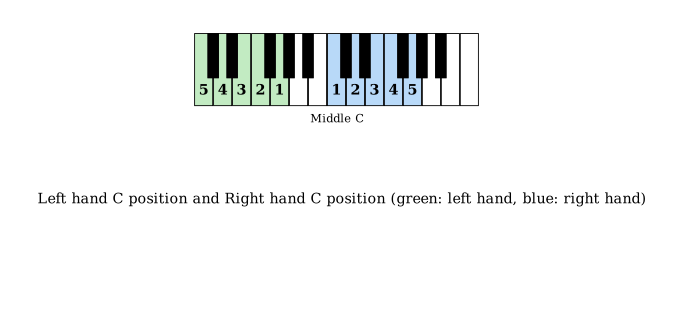
What is new
The skip (a third)
A skip jumps over one white key and one finger: C to E, D to F, E to G, and back down.
Skips on the staff
A step always goes from a line to a space or from a space to a line. A skip goes from a line to the next line, or from a space to the next space.
Fingers for skips
Skips use every other finger: 1 to 3, 2 to 4, or 3 to 5.
Chains of skips
C, E and G can follow each other. In the treble clef they sit on the ledger line, line 1 and line 2; in the bass clef they sit in three spaces in a row.
Part A: Right-hand skips ♩ = 60
Skips in the right hand, mixed with steps. Metronome 60.
Part B: Left-hand skips ♩ = 60
Skips in the left hand. In the bass clef, C, E and G sit in the second, third and top spaces.
Part C: Skips, hands taking turns ♩ = 66
Skips with the hands taking turns, in eight-bar phrases.
Pieces
Pieces are for playing more than once. Read each one first without stopping, like an exercise; then practise it until it sounds steady and musical.
Mary Had a Little Lamb ♩ = 84
Traditional
One skip only: E up to G in bar 4. Everything else moves by step or repeats.
Au clair de la lune ♩ = 76
Traditional French song (opening)
The right hand sings the phrase, then the left hand repeats it. Find the skip in bar 3 before you start.
Leapfrog ♩ = 72
Original
Skip, step, skip, step: the right hand hops up, then the left hand hops down from G.
Stepping Stones ♩ = 88
Original
Each bar steps down and then skips up, like crossing a stream on stones. Lean on beat 1.