Unit 3
Hands Take Turns
New: Melody passes between hands; 3/4 time and the dotted half note
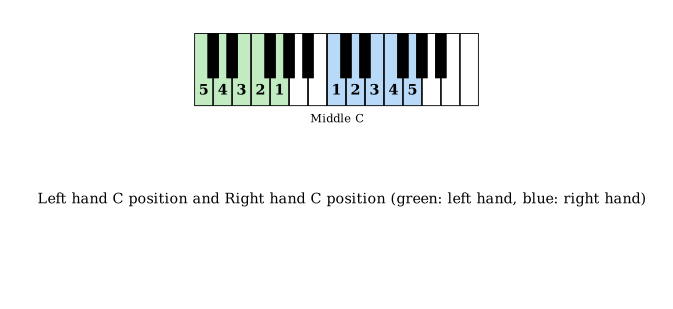
From now on both hands sit in C position at the same time: the left hand on C to G below middle C, the right hand on C to G from middle C. In this unit they take turns. One hand plays while the other waits, resting on its keys and ready. You will also meet a new time signature, 3/4.
What is new
Taking turns
The melody moves from one staff to the other. When it moves to the bass staff, the left hand plays; when it moves back up, the right hand plays.
Full-bar rests
A bar with only a rest in it means that hand is silent for the whole bar. In every time signature this is the whole-rest sign, a small block hanging under the fourth line.
3/4 time
Three beats in every bar. Count 1 - 2 - 3, and lean a little on beat 1, like a waltz.
The dotted half note
A dot adds half of the note's value: a half note (2 beats) plus its dot (1 beat) makes 3 beats, a full bar in 3/4.
Part A: Two bars each ♩ = 60
The melody passes between the hands every two bars. 4/4 time, metronome 60.
Part B: Three beats in a bar ♩ = 72
3/4 time, right hand only. New rhythm: the dotted half note, worth three beats.
Part C: Turns in 3/4 ♩ = 72
Eight-bar phrases in 3/4, with the hands taking turns.
Pieces
Pieces are for playing more than once. Read each one first without stopping, like an exercise; then practise it until it sounds steady and musical.
Echo ♩ = 72
Original
The left hand echoes the right hand an octave lower. Play the echo a little softer.
Waltz for Two Hands ♩ = 84
Original
One, two, three. The tune passes from hand to hand every two bars. Hold each dotted half note for all three beats.
The Swing ♩ = 80
Original
The right hand swings down from G, then the left hand answers from its own G.
Ode to Joy (shared) ♩ = 80
Ludwig van Beethoven (1824), simplified
The right hand plays the first half and the left hand finishes the tune. Be ready to start the left hand in bar 5.