Unit 5
Hands Together
New: Left hand holds C or G while the right hand moves
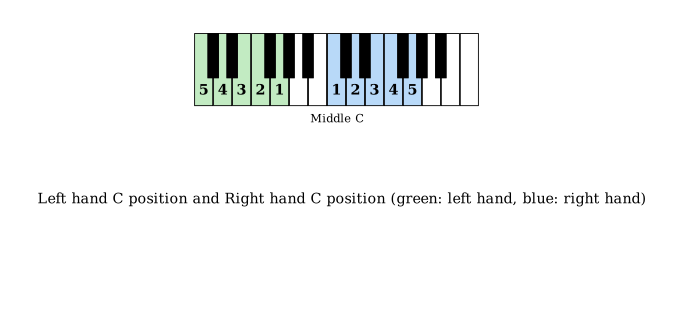
Both hands now play at the same time. To make this manageable, the left hand keeps it simple: it holds long notes, only C (finger 5) or G (finger 1), while the right hand plays the tune. These two bass notes are the roots of the two most important chords in C major.
What is new
Reading two staves at once
Notes that line up vertically are played together. Read the beat as a column: the right-hand note on top, the left-hand note below.
C and G in the bass
C sits in the second space (finger 5) and G in the top space (finger 1). In this unit those are the only two left-hand notes.
Where the bass changes
The left hand changes only on beat 1 (whole notes) or on beats 1 and 3 (half notes). Between those moments, spend all your attention on the right hand.
Part A: Whole-note bass ♩ = 56
The left hand holds one whole note per bar: C or G. The right hand moves by step. Metronome 56.
Part B: Half-note bass ♩ = 56
The left hand may change on beat 3 (half notes), and the right hand uses skips too.
Part C: Eight-bar duets for two hands ♩ = 60
Eight-bar duets for your two hands.
Pieces
Pieces are for playing more than once. Read each one first without stopping, like an exercise; then practise it until it sounds steady and musical.
Hot Cross Buns (hands together) ♩ = 72
Traditional (bar 3 simplified to quarter notes)
The left hand holds C, and changes to G only once, in bar 3.
Ode to Joy (hands together) ♩ = 76
Ludwig van Beethoven (1824), simplified
The bass alternates C and G every bar, then stays on C at the end. Bars 1-3 and 5-7 are the same.
Morning Song ♩ = 72
Original
The tune climbs the chain C-E-G in the first bar. The bass changes on beat 3 only in bar 7.
Bells in C ♩ = 84
Original
A waltz: the left hand rings one long bass note in every bar while the right hand sways.