Unit 10
Sharps, Flats and Review
New: Sharps, flats and key signatures (D and F positions); review of Units 1-9
Until now you have played only white keys. Sharps and flats take you to the black keys. This unit adds two new positions that each use one black key, and shows how a key signature tells you about it once, for the whole piece. The unit ends with a review of everything in Volume 1.
What is new
Sharp
A sharp sign before a note means: play the very next key to the right (higher), usually a black key. F-sharp is the black key between F and G.
Flat
A flat sign means: play the very next key to the left (lower). B-flat is the black key between A and B.
Natural
A natural sign cancels a sharp or flat: play the white key.
How long an accidental lasts
A sharp, flat or natural written in front of a note lasts until the end of that bar.
Key signature
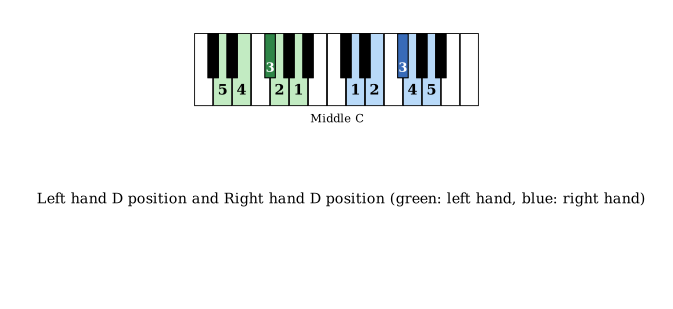
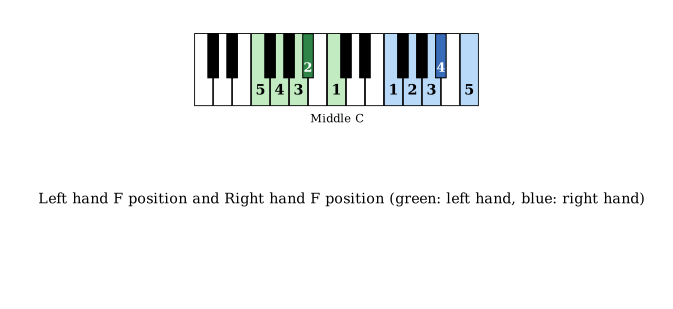
Sharps or flats at the start of every line apply to every note with that letter name, all the way through the piece. D major has F-sharp and C-sharp; F major has B-flat.
The two new positions
D position is D E F-sharp G A, with finger 3 on the black key. F position is F G A B-flat C, with finger 4 on the black key.
Part A: D position: F-sharp ♩ = 60
Right hand in D position, with the D major key signature. Metronome 60.
Part B: D position, left hand ♩ = 60
Left hand in D position. Bass D is the middle line, and F-sharp is the fourth line.
Part C: F position: B-flat ♩ = 60
Right hand in F position, with the F major key signature (B-flat).
Part D: Review: everything together ♩ = 60
Review: hands together in C position, using everything from Volume 1.
Pieces
Pieces are for playing more than once. Read each one first without stopping, like an exercise; then practise it until it sounds steady and musical.
Au clair de la lune in D ♩ = 76
Traditional French song (opening)
The tune from Unit 4, now in D position: every F is F-sharp because of the key signature.
Ode to Joy in D ♩ = 76
Ludwig van Beethoven (1824), simplified
Finger 3 starts on the black key F-sharp. The bass alternates D (finger 5) and A (finger 1).
Song in F ♩ = 72
Original
Finger 4 plays B-flat every time. The bass alternates F (finger 5) and middle C (finger 1).
Farewell Waltz ♩ = 84
Original
A goodbye to Volume 1, using skips, a 4th, eighths, a tie and a rest. Scan for each one before you play.