Unit 9
Eighth Notes
New: Two eighths per beat; counting 1-and-2-and
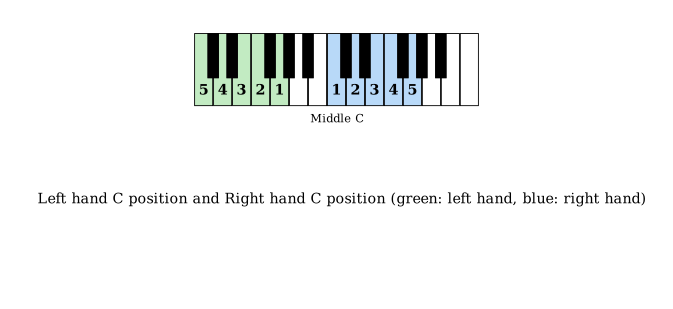
Eighth notes are twice as fast as quarter notes: two of them share one beat. They look like quarter notes with a flag, or joined in pairs by a beam. Back in C position for this unit, so all your attention can go to the new rhythm.
What is new
The eighth note
Half a beat. A single eighth note has a flag; two or more are usually joined by a beam.
Counting eighths
Say '1 and 2 and 3 and 4 and'. The number falls on the beat and 'and' falls halfway between beats. A pair of eighths is '1-and'.
Even eighths
Both eighths in a pair are the same length. Don't rush the second one.
Beams show the beat
Each beamed pair fills one beat, so beams help you see where the beats fall in the bar.
Part A: Eighths in the right hand ♩ = 60
Eighth notes in the right hand. Metronome 60: two eighths for each click.
Part B: Eighths, hands together ♩ = 60
Hands together: eighths on top, half notes in the bass.
Part C: Eighths in the left hand ♩ = 60
Eighth notes in the left hand.
Pieces
Pieces are for playing more than once. Read each one first without stopping, like an exercise; then practise it until it sounds steady and musical.
Hot Cross Buns (real rhythm) ♩ = 72
Traditional
Now bar 3 has its real rhythm: 'one a pen-ny, two a pen-ny', four eighths on C, then four on D.
Running Water ♩ = 66
Original
Four eighths run up or down, then two quarters rest the stream. Keep the eighths even.
Little Dance ♩ = 80
Original
A waltz with an eighth-note pair on beat 2. Count '1, 2-and, 3'.
Jingle Bells (chorus) ♩ = 92
James Lord Pierpont (1857), simplified
Sixteen bars on four lines. Bar 3 has a 5th, from G down to C, and bars 6 and 14 end with an eighth-note pair.