Unit 1
The Right Hand Finds Its Home
New: Treble clef, right hand C position, whole / half / quarter notes, 4/4
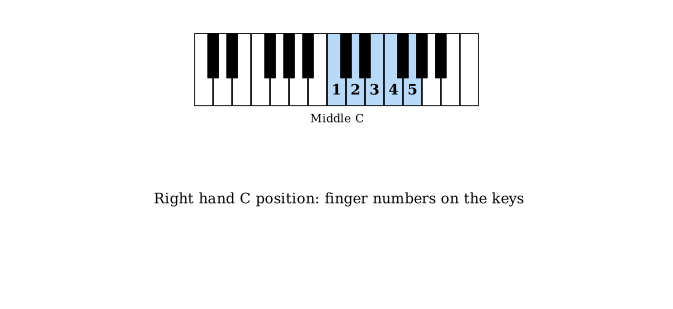
In this unit your right hand learns its first home on the keyboard: the C position. Put your right thumb (finger 1) on middle C and let fingers 2, 3, 4 and 5 rest on the next four white keys: D, E, F and G. Your hand does not move for the whole unit, so every note you read is already under a finger.
What is new
The treble clef
The curl of the treble clef wraps around the second line from the bottom. That line is G, the note under your little finger.
Middle C
Middle C sits on its own short line (a ledger line) just below the treble staff. It is your thumb.
Lines and spaces
Notes alternate line, space, line, space as they go up: C (ledger line), D (space under the staff), E (bottom line), F (first space), G (second line).
Note values
Whole note = 4 beats (open, no stem). Half note = 2 beats (open, with stem). Quarter note = 1 beat (filled in, with stem).
4/4 time
The top 4 means four beats in every bar. Count 1 - 2 - 3 - 4 out loud, steadily, in every bar.
Part A: Whole and half notes ♩ = 60
Long notes only: whole notes (4 beats) and half notes (2 beats). Set the metronome to 60 and count every beat aloud.
Part B: Quarter notes join in ♩ = 60
Now quarter notes (1 beat) join in. Keep the same steady 60. Notice how many exercises move in steps of a single finger.
Part C: Eight-bar phrases ♩ = 66
Eight-bar phrases, written on two lines. Look for bars that repeat: many phrases restart in bar 5 the same way they began in bar 1. Spotting a repeat means less to read.
Pieces
Pieces are for playing more than once. Read each one first without stopping, like an exercise; then practise it until it sounds steady and musical.
Hot Cross Buns ♩ = 72
Traditional (bar 3 simplified to quarter notes)
Three notes, one pattern. Bars 1, 2 and 4 are almost the same. One new move: after each C, skip back up to E (finger 1 to finger 3).
First Steps ♩ = 72
Original
A question (bars 1-4) and an answer (bars 5-8). The answer starts exactly like the question.
Seesaw ♩ = 76
Original
Repeated notes stay on the same line or space. Keep the half notes full: count 1 - 2, 3 - 4.
Ode to Joy ♩ = 80
Ludwig van Beethoven (1824), simplified
The famous theme from the Ninth Symphony uses only your five C-position notes. Bars 1-3 and 5-7 are identical; only the endings differ.